Industry-Leading Simulation and Optimization for Additive Manufacturing
Accelerate design, manufacturing, and qualification of even the largest and most complex production components by eliminating costly trial-and-error builds
We are the technical authority in AM and welding simulation, led by the pioneers of the field. Our team is an elite assembly of engineers from the world’s premier universities and global industrial leaders.
Our software is critical for enabling effective manufacturing and design across a variety of AM industry segments, including Aerospace, Defense, New Space, Energy, and Automotive. We have a network of partners and resellers that spans the globe.
A stable presence in the industry; our company is run on the licensing revenue of our products. We do not accept (let alone depend on) outside funding, making us accountable not to investors, but to our end-users.
PanOptimization headquarters is in State College, PA, show in black. Our offices are shown in orange, and resellers in blue.
PanX is a FEA platform that allows users to predict and optimize build outcomes virtually – eliminating failed builds that result from experimental trial and error.
Multi-Grid modeling represents a paradigm shift for the industry and makes traditional simulation techniques obsolete. PanX is fast becoming the industry standard for thermomechanical modeling of AM.
PanX LPBF is the only simulation tool on the market capable of accurately scaling to the size and complexity of modern LPBF parts.
Users can evaluate designs, compensate for distortion, predict and mitigate cracking, optimize dwell times to control heating, and control machine parameters for optimal melt quality and material properties.
PanX DED is the only simulation tool on the market capable of simulating part-scale DED parts.
Users can evaluate designs, fixturing, and toolpath strategies, compensate for distortion, predict and mitigate cracking, and optimize toolpath timing to achieve target interpass temperatures.
As AM continues to shift from research/prototyping to production applications, economics become critical. Parts must be printed “first-time right” and meet their design intent. Production print strategies must be optimized to avoid wasted time and money.
PanX is an enabling technology that allows users to simulate and optimize the thermomechanical response of the build process virtually, eliminating costly trial and error iterations and accelerating the time to reach a successful print.
PanX is specifically architected to accurately scale to large and complex production parts. It is the only solver on the market capable of doing so.
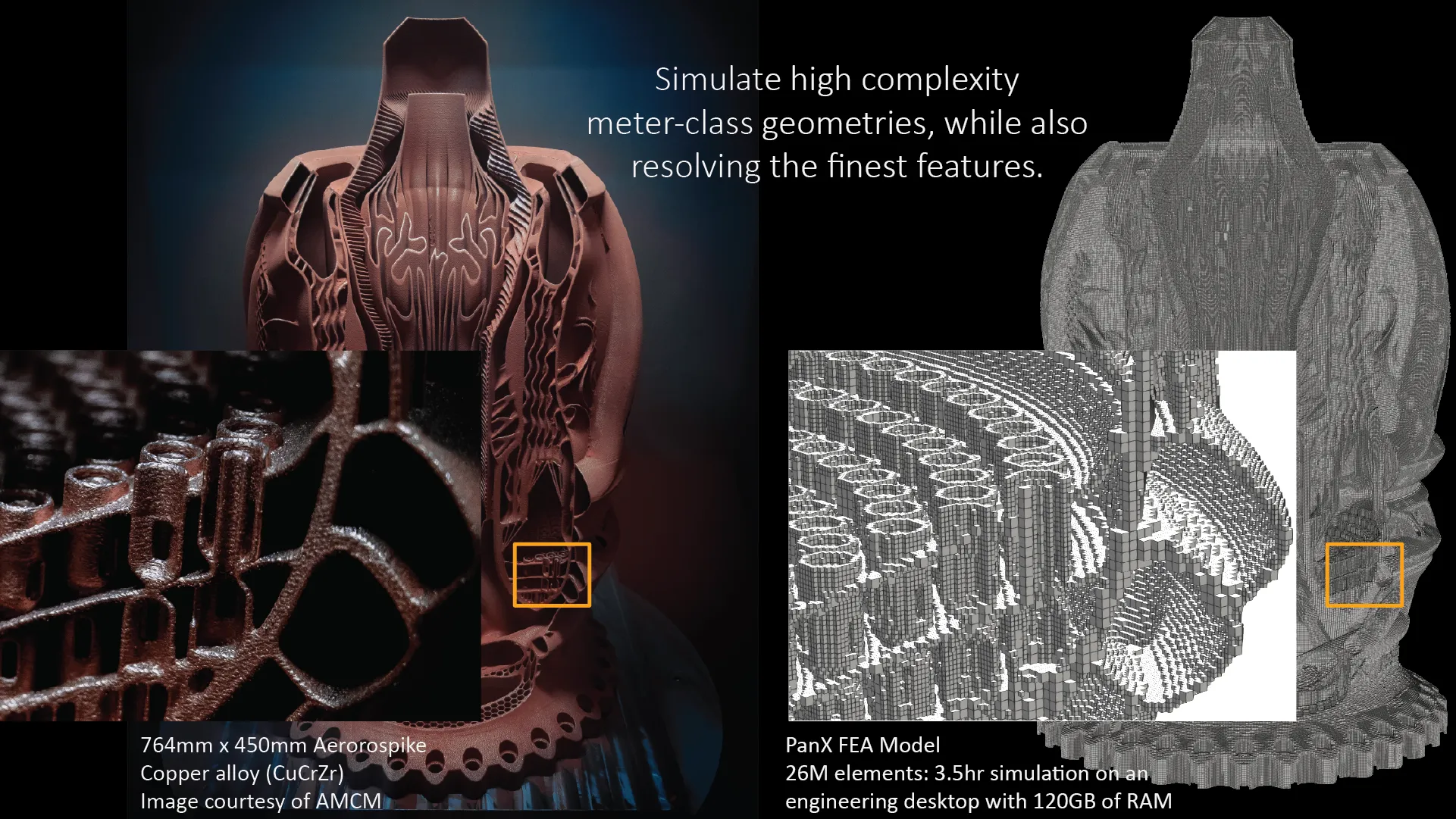
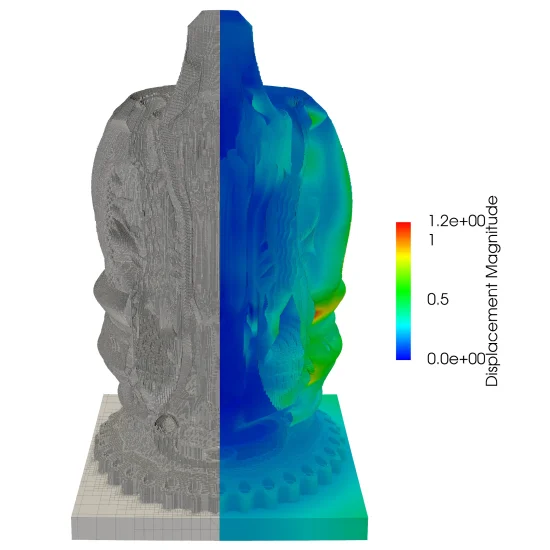
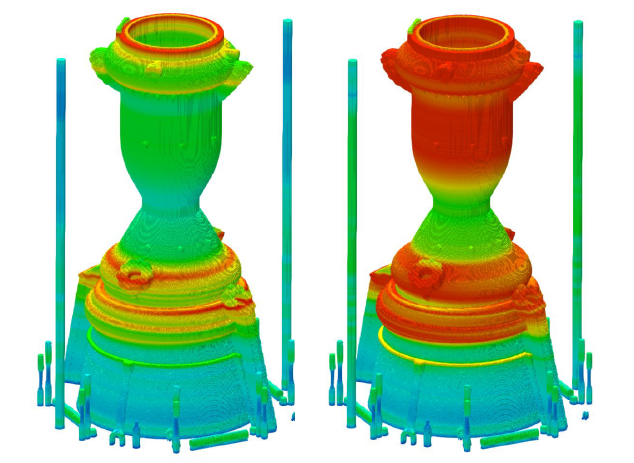
The AMCM Aerospike (right) requires over 26M nodes and 50M elements to mesh, making it ~10x too large to mesh (let alone solve) using traditional simulation approaches. This thermomechanical model in PanX completes in just 3.5 hours on an engineering desktop.
Aerospike (765mm tall)- Full-part LPBF aerospike FEA mesh (right) can resolve the smallest part features, as well as the entire build volume
Integrate Directly into Existing Workflows
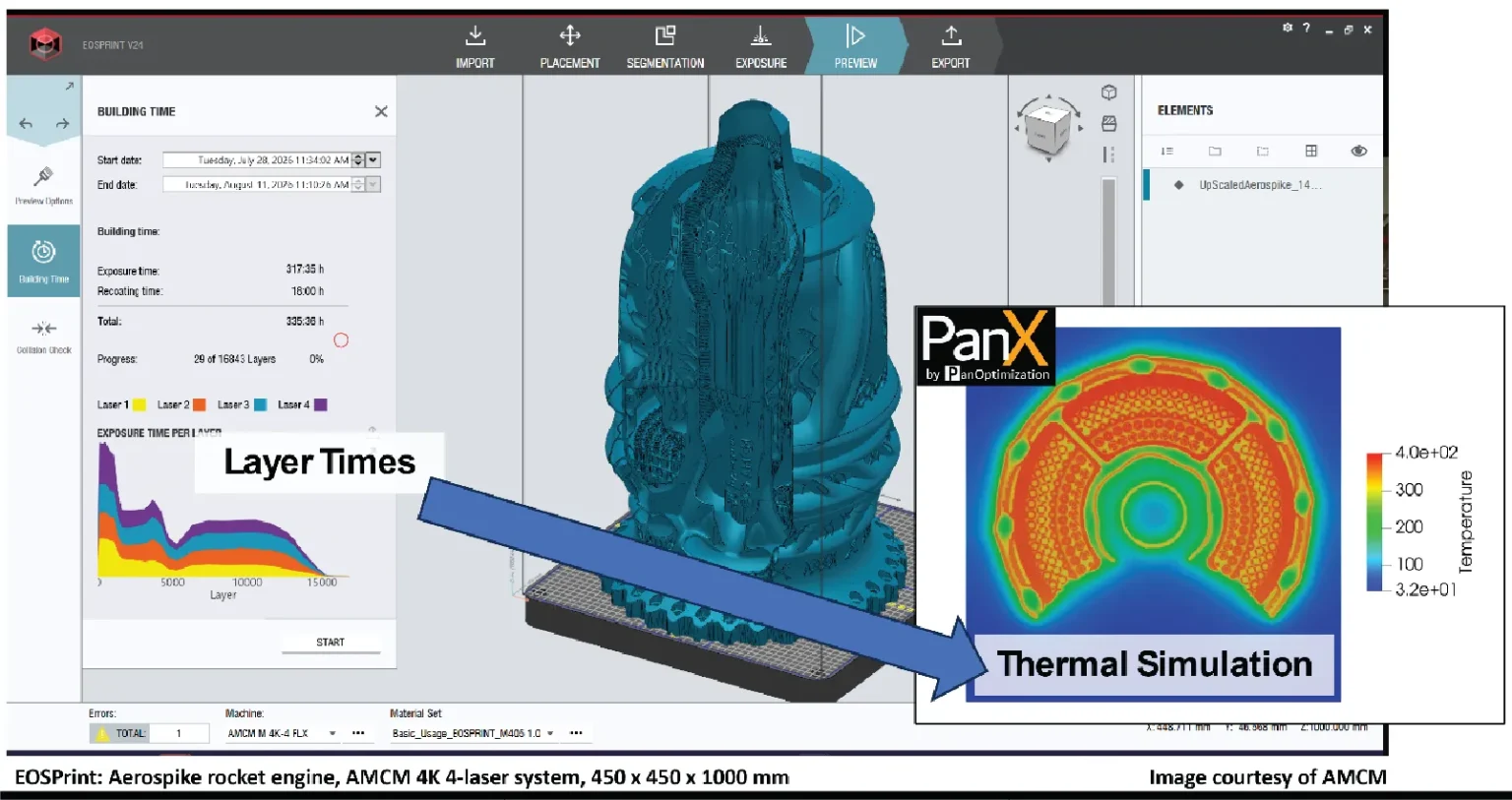
PanX integrates directly with existing design and manufacturing workflows. Simulation can be leveraged as early on as the design stage or as far downstream as the print stage.
Integrations eliminate redundant and error-prone setup, greatly improve simulation accuracy, and can easily be used by design and manufacturing engineers, rather than simulation experts.
All major OEM workflows are supported, including: Nikon, EOS, and Velo3D.
PanX - EOSPrint integration
Print First-Time Right
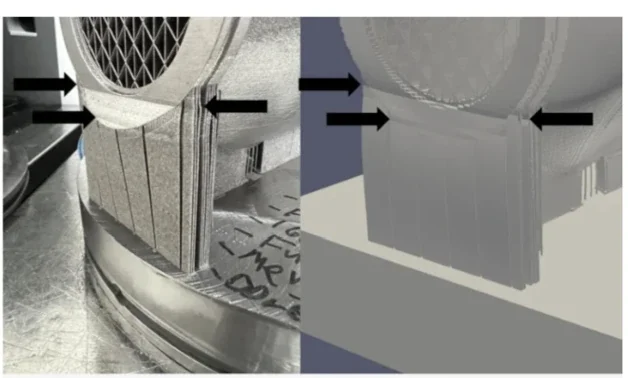
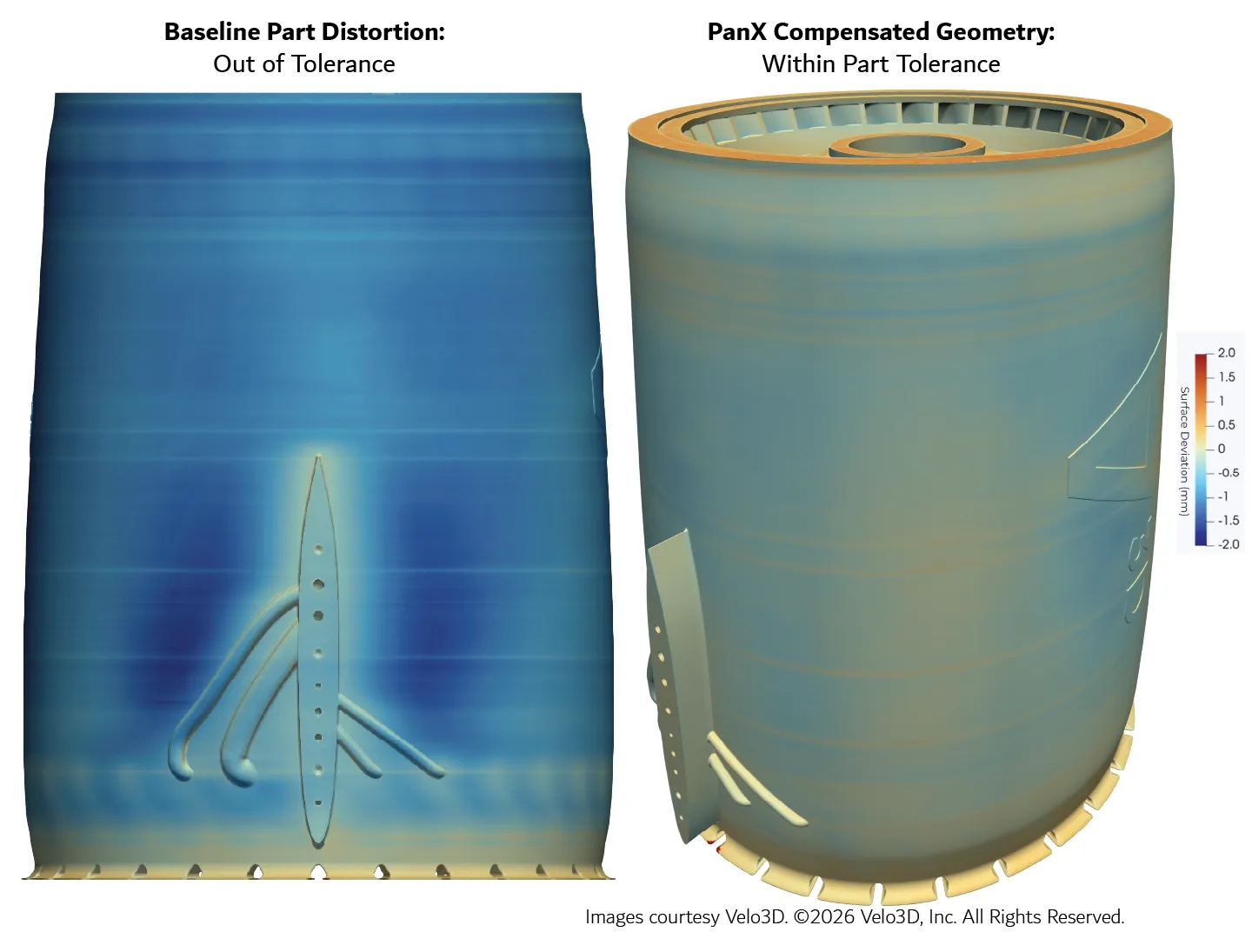
PanX predicts all common print failures (including buckling, bolt failure, powder sticking, recoater collisions, cracking, etc.) and compensates for distortion to meet dimensional tolerances. Distortion compensation had historically proven difficult prior to PanX, especially on large geometries where distortions get larger but required tolerances do not.
These capabilities combine to finally make “first-time right” printing a reality. A study by Velo3D on 12 Copper Nickel Alloy XC Large-format builds, including 33 geometries and taking 1756 print hours found that PanX assisted in producing first-time right prints on 11 of the 12 builds [1].
PanX distortion compensation allows this Microturbine Engine core (325mm x 357mm, 430mm) to be printed within tolerance (median distortion ~0.07mm) [1].
Enable and Accelerate Part Qualification
Historically, simulation has focused on residual stress and distortion. However, once a part is printed and meets the dimensional tolerance, that does not guarantee that it will meet its design intent. Failures during part testing/qualification remain common. This is primarily because material properties will vary throughout a part based on the thermal history of the print [2]. Since the thermal history is geometry dependent, the properties will not be as expected and will also not necessarily match the properties of neighboring witness coupons.
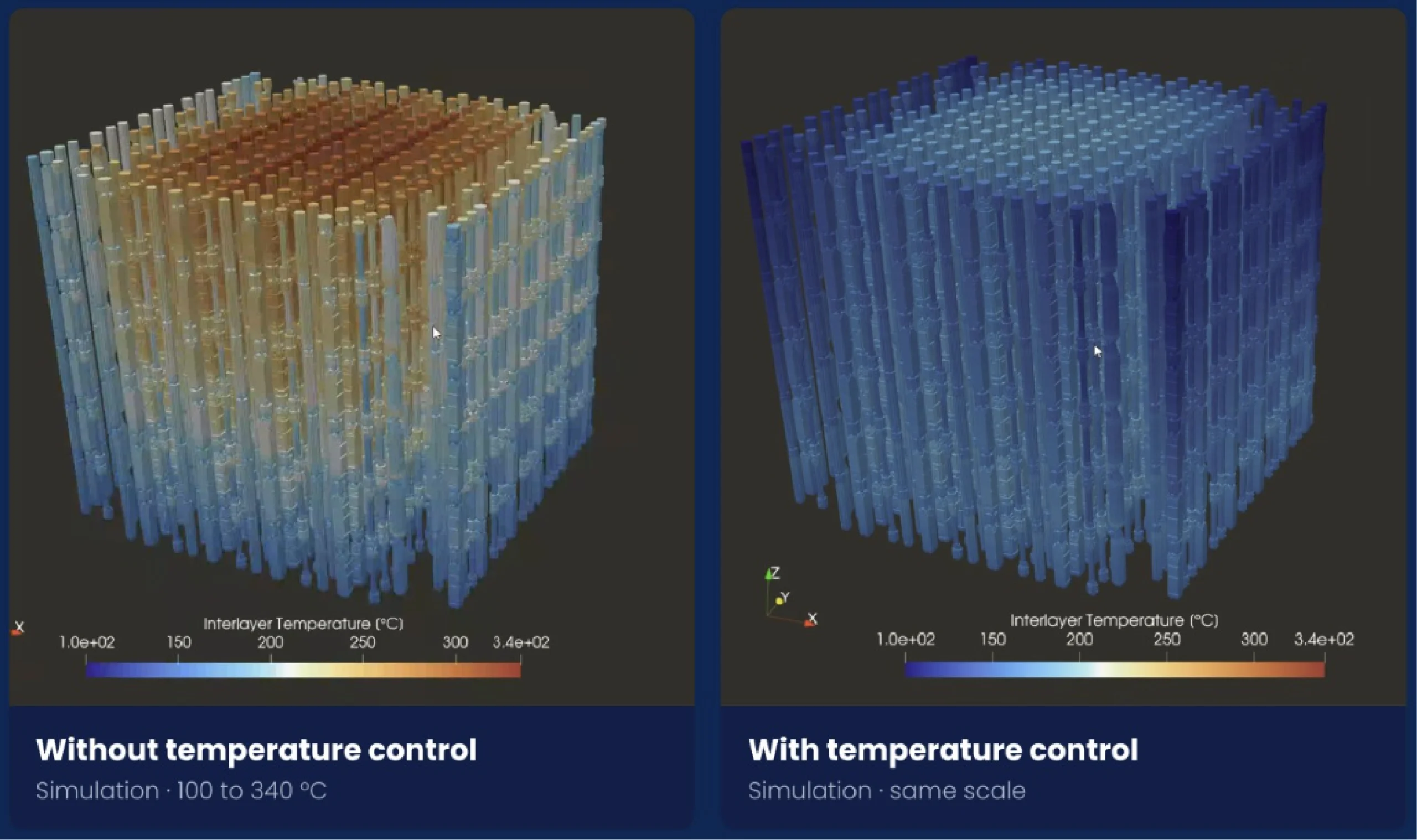
PanX offers a solution in the form process parameter [3] and dwell time optimization. Simulation-based feed-forward control of the process results in uniform material properties and increases the chance of successful part qualification.
PanX optimizes thermal dwell to control interlayer temperatures. Image courtesy of Nikon SLM Solutions.
Optimize Your Production Build Strategy
PanX optimizes build strategies and outcomes to minimize print times while maintain part quality. Modules offered include process parameter optimization [3] and dwell time optimization.
The Vast E-2 engine (below) was originally printed with
dwell times generated based on experience and print data
to achieve an acceptable flow coefficient through the
cooling channels.
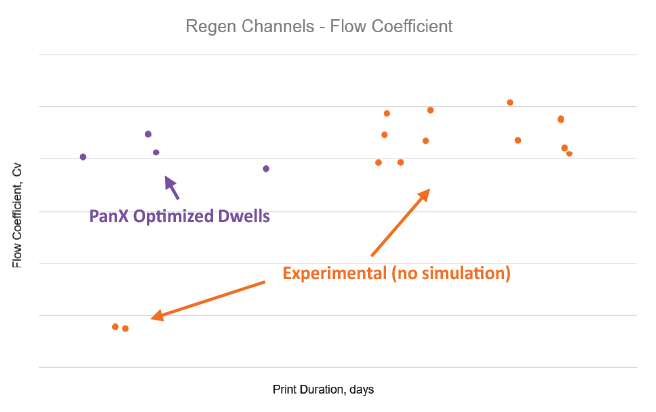
PanX optimized dwells were able to reduce the print time by
132 hrs (32%) while maintain the same flow coefficient. This
represents a cost savings of $12-20k per engine [4].
Interlayer temperatures using the original build strategy (left) and the PanX optimized dwell times (right). Note: The scale is the same in both images, but the magnitudes are not approved for public release. Image courtesy of Launcher (a Vast company).
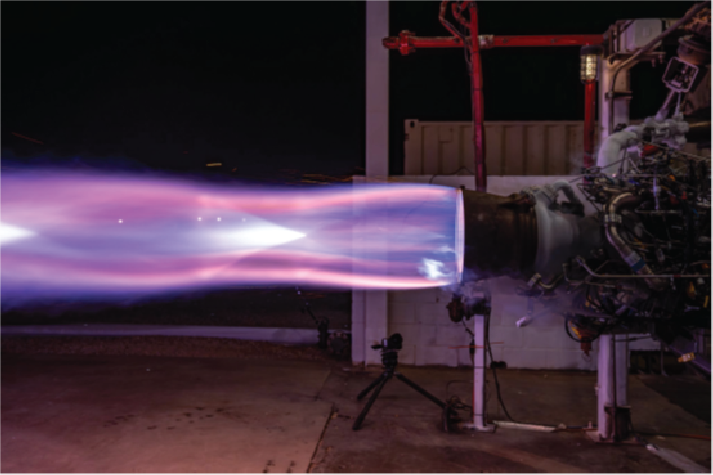
Launcher E-2 Engine. Image courtesy of Launcher (a Vast company).
Manually created dwell times (orange) resulted in unacceptably low flow coefficients or long build times. PanX computed optimal build strategies (purple) that resulted in acceptable flow coefficients, while reducing build time by 32%. Note: x-axis values are not approved for public release. Image courtesy of Launcher (a Vast company).
Get started
Contact us to speak directly with an engineer, learn more about our software capabilities, and get up and running with PanX.
[1] D. Driscoll. “Advancing First-Print Success Through Integrated Simulation and Data-Driven Manufacturability Analysis.” Velo3D, ASTM ICAM 2026.
[2] Q. Wang, P. Michaleris, Y. Ren, C. Dickman, E. Reutzel. Effect of interlayer temperature on melt-pool morphology in laser powder bed fusion. Addit. Manuf. Lett., 7 (2023), Article 100169
[3] P. Michaleris, E. Denlinger, Y. Wang, T. Nelson, Q. Wang, Laser power optimization for feedforward control of melt pools in laser powder bed fusion, Addit. Manuf. Lett., 19 (2026), Article 100420
[4] J. Cohen. “Thermomechanical Optimization of Large-Format Copper Combustion Chambers: Accurate and Compute-Efficient L-PBF Simulation.” Launcher (a Vast Company), ASTM ICAM 2026.